
House Hacking the District: How to Buy a Multi-Unit Property in D.C. with a VA Loan
House Hacking the District: How to Buy a Multi-Unit Property in D.C. with a VA Loan
If you are a veteran or active-duty service member stationed in the DMV, you are sitting on the single most powerful wealth-building tool in real estate: the VA Loan.
While most people use it to buy a standard single-family home, the real magic happens when you use it to purchase a multi-unit property (up to 4 units). In Washington, D.C.—where rent is high and real estate is premium—you can live in one unit and let your tenants pay your mortgage. It is the ultimate real estate strategy, often called "house hacking."
Here is your detailed, step-by-step instructional guide to executing this strategy in the nation's capital.
1. The Golden Rule: You Have to Live There
The VA loan is designed to help service members secure primary housing, not to act as a zero-down tool for hands-off corporate landlords.
- The 60-Day Rule: You must intend to move into one of the units as your primary residence within 60 days of closing.
- The 12-Month Rule: Most lenders expect you to maintain that unit as your primary residence for at least one year. After 12 months, you are completely free to move out, rent out your former unit, and turn the entire property into a pure cash-flowing investment.
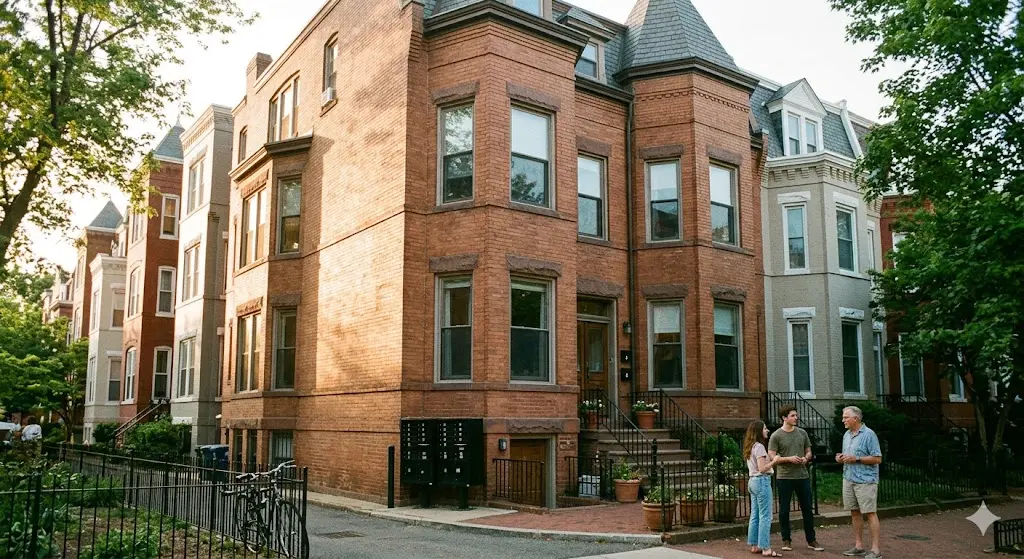
D.C. Real Estate Tip: In Washington, D.C., you don't just have to look for traditional duplexes or fourplexes. Keep an eye out for historic rowhouses featuring a legal "English basement" (an apartment on the lower level with a separate entrance) or properties with permitted Accessory Dwelling Units (ADUs). As long as the property is legally zoned for multiple units, the VA will recognize it.
2. D.C. Numbers & High-Cost Advantages
Washington, D.C. is classified as a high-cost market. If you have your full VA loan entitlement, the VA has actually eliminated loan limits entirely—meaning you can theoretically buy a multi-million dollar property with 0% down, provided you financially qualify for the monthly payments.
However, if you have partial entitlement (for instance, if you already own a home with a VA loan elsewhere), or if your lender utilizes local limits to calculate baseline caps, the 2026 high-cost multifamily loan benchmarks are scaled generously upward:
| Property Type | 2026 High-Cost Area Benchmarks |
|---|---|
| Duplex (2 Units) | $1,599,625 |
| Triplex (3 Units) | $1,933,600 |
| Fourplex (4 Units) | $2,403,375 |
Note: These limits reflect standard high-cost caps for 2026 under partial entitlement structures.
3. The Secret Weapon: Qualifying with Rental Income
Let's talk numbers. Buying a $1.2 million duplex in neighborhoods like Capitol Hill, Petworth, or Brookland might sound intimidating if you are relying solely on your base military or civilian salary.
Fortunately, the VA allows you to use the projected rental income of the other units to help you qualify for the loan.
- The 75% Rule: Lenders will look at the market rent of the unoccupied units and let you use 75% of that projected income to offset your debt-to-income (DTI) ratio. The remaining 25% is subtracted to account for potential vacancies and maintenance.
- The Underwriting Catch: To use this future rent to qualify, underwriters typically require you to show two years of documented landlord experience OR hire a professional property management company to handle the building. In a transient, busy city like D.C., hiring a local property manager is usually the easiest route to satisfy the lender and protect your sanity.
4. Step-by-Step Instructional Guide to Closing
Step 1: Secure Your Certificate of Eligibility (COE)
Before you start looking at open houses, log into the VA portal or have a VA-approved lender pull your COE. This document proves your service history and explicitly states whether you have full or partial entitlement.
Step 2: Hire a D.C.-Savvy Real Estate Agent
D.C. housing codes and zoning laws are complex. You need an agent who knows how to spot the difference between a "legal multi-unit" and a single-family home that someone just put a lock on. Your agent must ensure the property satisfies the VA’s Minimum Property Requirements (MPRs), which mandate that the property is safe, structurally sound, and that each unit has its own separate utility meters or clear, working systems.
Step 3: Account for the VA Funding Fee
Unless you have a VA disability rating of 10% or higher (which completely exempts you), you will pay a one-time VA Funding Fee at closing. For a first-time user taking advantage of a zero-down payment, the fee is 2.15% of the loan amount; for subsequent uses, it rises to 3.30%. This fee can be rolled directly into your total loan balance so you don't have to pay it out of pocket.
Step 4: Close, Move In, and Build Equity
Once your offer is accepted and the VA appraisal clears, you will close on the home. Move into your unit, get your tenants signed to solid leases (be sure to familiarize yourself with D.C.’s tenant-friendly rental laws), and watch your tenants build your net worth month after month.
Ready to Take Control of Your Financial Future?
Don't let your housing allowance simply vanish into a landlord's pocket every month. By leveraging your VA loan on a multi-family property right here in Washington, D.C., you can establish a powerful engine for long-term wealth creation.
Whether you are stationed at the Pentagon, JBAB, or working in the private sector, our team specializes in helping veterans navigate the complex D.C. multifamily market. Contact us today for a free strategy session, and let's find the perfect property to jumpstart your real estate portfolio!
Categories
Recent Posts